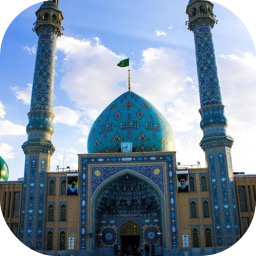

The Guardianship
The Prophet's Household (AS): From Divine Selection to Prophetic Authority
In the Quranic and prophetic usage, the Prophet's Household (AS) are the People of the Cloak and the infallibles from the progeny of the Prophet (PBUH), whom God made a purified authority to preserve the religion and expound the Quran after the Messenger of God.
The concept of “Ahl al-Bayt” (the Prophet’s Household) represents a pivotal point of reference in Islamic thought for understanding the line of prophetic continuation after the seal of God’s prophets (PBUHPBUH — pronounced ‘sal-lal-LAAH-u alayhi wa aalih’ — صلى الله عليه وآله Peace and blessings be upon him and his family. This expression is used after mentioning Prophet Muhammad (PBUH) as an act of reverence and obedience to the Quranic command to send blessings upon him.). Knowing who the Household are, defining their stations, and refuting the doubts about them is among the epistemic necessities for every seeker of the Quranic and narrated truth.
1. Defining Ahl al-Bayt (AS) and Responding to the Doubt of Including the Relatives
Some intellectual theses try to broaden the concept of “Ahl al-Bayt” to include the wives of the Prophet (PBUHPBUH — pronounced ‘sal-lal-LAAH-u alayhi wa aalih’ — صلى الله عليه وآله Peace and blessings be upon him and his family. This expression is used after mentioning Prophet Muhammad (PBUH) as an act of reverence and obedience to the Quranic command to send blessings upon him.) or his whole family and relatives, relying on the common linguistic sense of “the people of the house” — that is, the residents of the home.
The Scholarly Response to the Doubt
When a word occurs in the the Quranthe Quran — pronounced ‘al-Qur'an’ — القرآن Pronounced: al-Qur'an. The Quran is the central scripture of Islam. Muslims believe it is the revealed word of God, sent to Prophet Muhammad (PBUH), and preserved as the primary source for Islamic belief, worship, law, ethics, and spiritual guidance. joined to a particular praise or a legislative station such as purification, it shifts from its general linguistic sense to its specific technical, legal sense defined by the exposition of the Prophet (PBUHPBUH — pronounced ‘sal-lal-LAAH-u alayhi wa aalih’ — صلى الله عليه وآله Peace and blessings be upon him and his family. This expression is used after mentioning Prophet Muhammad (PBUH) as an act of reverence and obedience to the Quranic command to send blessings upon him.). There are decisive proofs that the wives are outside this most-specific concept:
- The grammatical evidence (context and pronouns): the context of the verses before and after the Verse of Purification came with the feminine pronoun addressing the wives:
“And abide in your houses.” (Al-Ahzab: 33)
“You are not like any other women.” (Al-Ahzab: 32)
But upon reaching the Verse of Purification, the address shifted to the sound masculine plural:
“…from you…” (‘ankum)
“…and purify you…” (yutahhirakum) (Al-Ahzab: 33)
This proves the entry of men into the address and a complete change of the ones addressed.
- The evidence of actual restriction (the People of the Cloak): the authentic collections, such as Sahih Muslim and al-Mustadrak, report that the Prophet (PBUHPBUH — pronounced ‘sal-lal-LAAH-u alayhi wa aalih’ — صلى الله عليه وآله Peace and blessings be upon him and his family. This expression is used after mentioning Prophet Muhammad (PBUH) as an act of reverence and obedience to the Quranic command to send blessings upon him.) enfolded Ali, Fatima, al-Hasan, and al-Husayn (ASAS — pronounced ‘alayhi as-salaam’ — عليه السلام AS stands for “peace be upon him / her / them.” It is the English abbreviation of the Arabic expression “alayhi / alayha / alayhim as-salam.” This expression is used after mentioning prophets (AS), the Imams (AS), Lady Fatima (AS), Sayyida Zaynab (AS), Lady Khadijah (AS), and Ahl al-Bayt (AS) as a sign of respect.) in a cloak and said:
“O Allah, these are my Household.”
And when his wife Umm Salama (28 BH–62 AH / 596–681 CE) asked to enter under the cloak, saying, “Am I not of the Household?”, the Prophet prevented her out of courtesy and said:
“You are toward good, and you are among the wives of the Prophet.”
And in another report:
“Stay in your place; you are upon good.”
Had the station been familial or inclusive of the wives, the Prophet would not have prevented her and directed her to a different praise.
Accordingly, Ahl al-Bayt in the most-specific sense are the pure elite whose obedience is enjoined, whom the Prophet (PBUHPBUH — pronounced ‘sal-lal-LAAH-u alayhi wa aalih’ — صلى الله عليه وآله Peace and blessings be upon him and his family. This expression is used after mentioning Prophet Muhammad (PBUH) as an act of reverence and obedience to the Quranic command to send blessings upon him.) explicitly designated and joined to the Quran.
2. The Fourteen Infallibles (The Great Lights of Purity)
This rank includes fourteen infallibles whose absolute purity from every defilement, error, and forgetfulness is established: the Messenger, al-Zahra, and the Twelve Imams.
1. The Messenger and al-Zahra (AS)
-
The noble Messenger Muhammad ibn Abdullah (PBUHPBUH — pronounced ‘sal-lal-LAAH-u alayhi wa aalih’ — صلى الله عليه وآله Peace and blessings be upon him and his family. This expression is used after mentioning Prophet Muhammad (PBUH) as an act of reverence and obedience to the Quranic command to send blessings upon him.) (53 BH–11 AH / 570–632 CE): the seal of the prophets and messengers, and the father of Fatima al-Zahra (ASAS — pronounced ‘alayhi as-salaam’ — عليه السلام AS stands for “peace be upon him / her / them.” It is the English abbreviation of the Arabic expression “alayhi / alayha / alayhim as-salam.” This expression is used after mentioning prophets (AS), the Imams (AS), Lady Fatima (AS), Sayyida Zaynab (AS), Lady Khadijah (AS), and Ahl al-Bayt (AS) as a sign of respect.). His father: Abdullah ibn Abd al-Muttalib (AS); his mother: Amina bint Wahb (AS). It is established in the reports of the Household (AS) that he was martyred by poison that was administered to him, and he was buried in Medina.
-
Lady Fatima al-Zahra (Lady Fatima (AS)Lady Fatima (AS) — pronounced ‘FAA-ti-ma’ — فاطمة (ع) Lady Fatima al-Zahra (AS) — daughter of Prophet Muhammad (PBUH), wife of Imam Ali (AS), and mother of Imam Hasan and Imam Husayn (AS). She is counted among Ahl al-Bayt.) (8 BH–11 AH / 614–632 CE): the part of the Messenger, daughter of Muhammad ibn Abdullah (PBUH) and wife of Imam Ali (AS). Her father: the Messenger of God Muhammad ibn Abdullah (PBUH); her mother: the Mother of the Believers Khadija bint Khuwaylid (AS). She was martyred, wronged, affected by her wounds from the assault and the painful events that occurred a few months after the passing of the Messenger (PBUH); she died in Medina and was buried secretly, and the location of her grave is not precisely known.
2. The Twelve Imams (AS)
They are the successors whom the Messenger (PBUHPBUH — pronounced ‘sal-lal-LAAH-u alayhi wa aalih’ — صلى الله عليه وآله Peace and blessings be upon him and his family. This expression is used after mentioning Prophet Muhammad (PBUH) as an act of reverence and obedience to the Quranic command to send blessings upon him.) explicitly designated in mass-transmitted reports, and we present them here in their order with their introductory lines:
-
Imam Ali ibn Abi Talib (Imam Ali (AS)Imam Ali (AS) — pronounced ‘i-MAAM a-LEE’ — علي (ع) Imam Ali ibn Abi Talib (AS) — cousin and son-in-law of Prophet Muhammad (PBUH), husband of Lady Fatimah (AS), and the first of the Twelve Imams in the Shia tradition.) (23 BH–40 AH / 599–661 CE): the Commander of the Faithful, the successor of the Messenger of God (PBUH) and his gate. His father: Abu Talib ibn Abd al-Muttalib (AS) (c. 85 BH–3 BH / c. 539–619 CE); his mother: Fatima bint Asad (AS). He was martyred, slain by the sword at the hand of Abd al-Rahman ibn Muljam (d. 40 AH / 661 CE) in his prayer niche, and was buried in Najaf al-Ashraf.
-
Imam al-Hasan ibn Ali al-Mujtaba (AS) (3–50 AH / 625–670 CE): the elder grandson and the fourth of the People of the Cloak. His father: Imam Ali ibn Abi Talib (AS); his mother: Lady Fatima al-Zahra (AS). He was martyred, slain by poison administered to him, and was buried in al-Baqi in Medina.
-
Imam al-Husayn ibn Ali the Martyr (AS) (4–61 AH / 626–680 CE): the younger grandson and the fifth of the People of the Cloak. His father: Imam Ali ibn Abi Talib (AS); his mother: Lady Fatima al-Zahra (AS). He was martyred, his noble head severed in the Battle of al-Taff at the hand of the army of Yazid ibn Mu’awiya, and was buried in sacred Karbala.
-
Imam Ali ibn al-Husayn al-Sajjad (AS) (38–95 AH / 659–713 CE): Zayn al-Abidin. His father: Imam al-Husayn ibn Ali (AS); his mother: Lady Shahzanan (AS) (Ghazala). He was martyred by poison at the instigation of al-Walid ibn Abd al-Malik (50–96 AH / 668–715 CE), and was buried in al-Baqi in Medina.
-
Imam Muhammad ibn Ali al-Baqir (AS) (57–114 AH / 676–733 CE): the one who split open the knowledge of the prophets. His father: Imam Ali ibn al-Husayn al-Sajjad (AS); his mother: Lady Fatima bint al-Hasan (AS) (Umm Abdullah). He was martyred by poison administered by Hisham ibn Abd al-Malik (72–125 AH / 691–743 CE), and was buried in al-Baqi in Medina.
-
Imam Ja’far ibn Muhammad al-Sadiq (AS) (83–148 AH / 702–765 CE): the head of the school and the renewer of the Sharia. His father: Imam Muhammad ibn Ali al-Baqir (AS); his mother: Lady Umm Farwa bint al-Qasim (AS). He was martyred by poison at the command of al-Mansur al-Dawaniqi (95–158 AH / 714–775 CE), and was buried in al-Baqi in Medina.
-
Imam Musa ibn Ja’far al-Kazim (AS) (128–183 AH / 745–799 CE): the monk of the family of Muhammad and the ally of the long prostration. His father: Imam Ja’far ibn Muhammad al-Sadiq (AS); his mother: Lady Hamida al-Musaffat al-Maghribiyya (AS). He was martyred by poison inside the prison of al-Sindi ibn Shahik by the command of Harun al-Rashid (149–193 AH / 766–809 CE), and was buried in al-Kazimiyya in Baghdad.
-
Imam Ali ibn Musa al-Rida (AS) (148–203 AH / 765–818 CE): the stranger of Tus and the guarantor of the gardens of Paradise. His father: Imam Musa ibn Ja’far al-Kazim (AS); his mother: Lady Najma (AS) (Tuktam). He was martyred by poison administered to him in grapes and pomegranate by the command of the Abbasid caliph al-Ma’mun (170–218 AH / 786–833 CE), and was buried in Mashhad in Tus.
-
Imam Muhammad ibn Ali al-Jawad (AS) (195–220 AH / 811–835 CE): the gate of what is sought, and the youngest of the Imams in age at the time of the imamate. His father: Imam Ali ibn Musa al-Rida (AS); his mother: Lady Sabika (AS) (al-Khayzuran). He was martyred by poison administered by his wife Umm al-Fadl at the prompting of the Abbasid al-Mu’tasim (179–227 AH / 796–842 CE), and was buried in al-Kazimiyya in Baghdad.
-
Imam Ali ibn Muhammad al-Hadi (AS) (212–254 AH / 827–868 CE): the possessor of eminence, piety, and purity. His father: Imam Muhammad ibn Ali al-Jawad (AS); his mother: Lady Samana al-Maghribiyya (AS). He was martyred by poison at the command of the Abbasid al-Mu’tazz (232–255 AH / 847–869 CE), and was buried in Samarra.
-
Imam al-Hasan ibn Ali al-Askari (AS) (232–260 AH / 846–874 CE): the father of the rescuer of humanity. His father: Imam Ali ibn Muhammad al-Hadi (AS); his mother: Lady Hadith (AS) (Salil). He was martyred by poison administered by the Abbasid al-Mu’tamid (229–279 AH / 844–892 CE), and was buried in Samarra.
-
Imam Muhammad ibn al-Hasan al-Mahdi (Imam al-Mahdi (AS)Imam al-Mahdi (AS) — pronounced ‘al-MAH-dee’ — المهدي (ع) Imam al-Mahdi (AS) — the twelfth and final Imam in the Shia tradition, believed to be in occultation and awaited as the one who will establish justice across the earth.) (may God hasten his relief) (255 AH / 869 CE – living, in occultation): the awaited Riser and the Proof who will take the vengeance of the prophets. His father: Imam al-Hasan ibn Ali al-Askari (AS); his mother: Lady Narjis (AS). He is the living, awaited Imam, hidden by God’s command to fill the earth with equity and justice after it has been filled with oppression and injustice.
3. The Ranks and Structure of the Household (The Difference Between the Greater Infallibility and the Acquired One)
To understand the rest of the blessed prophetic tree, one must know that “the Household” comprises several circles and ranks.
1. The Greater Infallibility Versus the Lesser Infallibility
-
The greater (essential) infallibility (infallibility and divine protection from errorinfallibility and divine protection from error — pronounced ‘IS-mah’ — العصمة The Arabic term is Isma. In Shia theology, it means God's protection from sin, deliberate error, forgetfulness that would damage religious guidance, and misguidance. For prophets and Imams, it safeguards the reliability of revelation and guidance.): it is the station of the Fourteen Infallibles exclusively; it is a divine confirmation and a creational purification that prevents the deliberate and inadvertent issuance of error and sin from birth until death, and makes its possessor an absolute divine proof.
-
The lesser (acquired) infallibility: it is a lofty rank of piety and God-consciousness that a human being reaches by his spiritual striving and his absolute obedience to the infallible, such that he develops a psychic disposition that prevents him from disobedience, even though forgetfulness is possible in his case and he has no text of divine guardianship.
-
The people of high stations (AS): in this rank fall noble personalities such as Lady Zaynab the Elder (5–62 AH / 626–682 CE), Abu al-Fadl al-Abbas (26–61 AH / 647–680 CE), and Ali al-Akbar (c. 33–61 AH / c. 653–680 CE) (ASAS — pronounced ‘alayhi as-salaam’ — عليه السلام AS stands for “peace be upon him / her / them.” It is the English abbreviation of the Arabic expression “alayhi / alayha / alayhim as-salam.” This expression is used after mentioning prophets (AS), the Imams (AS), Lady Fatima (AS), Sayyida Zaynab (AS), Lady Khadijah (AS), and Ahl al-Bayt (AS) as a sign of respect.), and the rest of the noble children of the Imams. These are of the Household in the sense of lineage and exemplarity, and their station with God is very great, and we address them with “peace be upon them” in reverence for their striving and their knowledge — such as the God-given knowledge acquired by Lady Zaynab — but they are not among the Fourteen Proofs.
2. The Sayyids (The Genealogical Progeny)
They are the descendants of the Household and their lineage extended across the ages from the progeny of Imam Ali and Lady Fatima (AS). In the Sharia we hold for them every honor, love, and respect, in honor of the Messenger of God (PBUHPBUH — pronounced ‘sal-lal-LAAH-u alayhi wa aalih’ — صلى الله عليه وآله Peace and blessings be upon him and his family. This expression is used after mentioning Prophet Muhammad (PBUH) as an act of reverence and obedience to the Quranic command to send blessings upon him.) and in compliance with his counsel to safeguard him in his progeny. But they are human beings like the rest of the people in obligation and responsibility, possessing neither infallibility nor legislative guardianship; rather their sin is doubled and their reward is doubled, for the standing of their lineage and their honored nearness.
4. The Stations and Virtues of the Household (AS) in the Demonstrative System
The proofs of the virtue of the Household (ASAS — pronounced ‘alayhi as-salaam’ — عليه السلام AS stands for “peace be upon him / her / them.” It is the English abbreviation of the Arabic expression “alayhi / alayha / alayhim as-salam.” This expression is used after mentioning prophets (AS), the Imams (AS), Lady Fatima (AS), Sayyida Zaynab (AS), Lady Khadijah (AS), and Ahl al-Bayt (AS) as a sign of respect.) do not stop at a single text; rather the proofs come together to form a coherent system that establishes their special station in guidance, in being followed, in religious authority, and in preference over all creation.
1. The Proofs from the Noble Quran
- The Verse of Purification (the proof of absolute purity):
“Allah only wishes to remove all impurity from you, O People of the House, and to purify you with a thorough purification.” (Al-Ahzab: 33)
The restricting particle “only” (innama) indicates a creational divine will that restricted the removal of “impurity” — that is, sins, error, and forgetfulness — to these righteous ones, and this is the proof of infallibility and divine protection from errorinfallibility and divine protection from error — pronounced ‘IS-mah’ — العصمة The Arabic term is Isma. In Shia theology, it means God's protection from sin, deliberate error, forgetfulness that would damage religious guidance, and misguidance. For prophets and Imams, it safeguards the reliability of revelation and guidance..
- The Verse of Affection (making their love a wage for the message):
“Say: I do not ask you for any wage for it except affection toward the near kin.” (Al-Shura: 23)
This verse does not present love of the near kin as an optional emotion, but links it to the wage of the message. And it is known that the Prophet (PBUHPBUH — pronounced ‘sal-lal-LAAH-u alayhi wa aalih’ — صلى الله عليه وآله Peace and blessings be upon him and his family. This expression is used after mentioning Prophet Muhammad (PBUH) as an act of reverence and obedience to the Quranic command to send blessings upon him.) does not seek a personal wage for himself, for his wage is upon God; this indicates that the affection for the near kin is a benefit returning to the nation itself, because their love is a path to preserving the religion and connecting to the springs of guidance. Had the affection been a mere family love, it would not have been made the wage of the final message; what is meant is an affection that leads to following and submission.
- The Verse of Guardianship (the proof of religious, leadership guardianship):
“Your guardian is only Allah, His Messenger, and those who believe — those who establish prayer and give charity while bowing.” (Al-Ma’ida: 55)
The verse restricted guardianship in a single continuous sequence extending from the guardianship of God and His Messenger to the believer who gave charity while bowing, and what is meant here is a religious, leadership guardianship, not a mere general love. It was revealed concerning Imam Ali ibn Abi Talib (AS) when he gave his ring in charity while bowing.
- The Verse of Mubahala (the proof of preference and spiritual equivalence):
“So say: Come, let us call our sons and your sons, our women and your women, ourselves and yourselves.” (Al ‘Imran: 61)
It placed Imam Ali at the station of the “self” of the noble Messenger, restricted the sons to al-Hasan and al-Husayn, and the women to Fatima — a decisive indication of complete preference; for had there been in the nation one more excellent than them, the Prophet would have performed the mutual invocation with him.
- The Verse of Blessing Upon the Prophet and His Family (their conjunction in daily worship):
“Indeed, Allah and His angels send blessings upon the Prophet. O you who believe, send blessings upon him and greet him with peace.” (Al-Ahzab: 56)
The Prophet (PBUHPBUH — pronounced ‘sal-lal-LAAH-u alayhi wa aalih’ — صلى الله عليه وآله Peace and blessings be upon him and his family. This expression is used after mentioning Prophet Muhammad (PBUH) as an act of reverence and obedience to the Quranic command to send blessings upon him.) clarified how to send blessings upon him, and it was:
“O Allah, send blessings upon Muhammad and the family of Muhammad.”
This repeated conjunction in the daily prayer is proof of the particularity of their station, and that the “family” here is a title of selection and an extension of guidance that we are specifically commanded to venerate.
- The Verse of Feeding Food (the station of sincerity):
“And they feed, out of love for Him, the needy, the orphan, and the captive, [saying]: We feed you only for the sake of Allah.” (Al-Insan: 8–9)
It is a Quranic documentation of their absolute sincerity and their piety that surpassed the bounds of ordinary human action.
- The Verse of Those in Authority:
“Obey Allah and obey the Messenger and those in authority among you.” (Al-Nisa: 59)
It entails the obligation of absolute obedience that follows the obedience of the infallibles.
2. The Proofs from the Widely and Mass-Transmitted Reports
- The Hadith of the Two Weighty Things (the infallible authority): the Messenger of God (PBUHPBUH — pronounced ‘sal-lal-LAAH-u alayhi wa aalih’ — صلى الله عليه وآله Peace and blessings be upon him and his family. This expression is used after mentioning Prophet Muhammad (PBUH) as an act of reverence and obedience to the Quranic command to send blessings upon him.) said:
“Indeed, I am leaving among you the two weighty things: the Book of God and my progeny, my Household. As long as you hold fast to them, you will never go astray after me, and they will never separate until they return to me at the Pool.”
This is a decisive text commanding to follow and hold fast to both together as an absolute guarantee against misguidance.
- The Hadith of Ghadir (the public proclamation of guardianship): he (PBUHPBUH — pronounced ‘sal-lal-LAAH-u alayhi wa aalih’ — صلى الله عليه وآله Peace and blessings be upon him and his family. This expression is used after mentioning Prophet Muhammad (PBUH) as an act of reverence and obedience to the Quranic command to send blessings upon him.) said at Ghadir Khumm after the Farewell Pilgrimage, before the crowds:
“Whoever’s guardian I am, this Ali is his guardian.”
This proclamation was linked to his saying:
“Am I not more entitled to the believers than themselves?”
So the meaning of guardianship here became an extension of the Prophet’s legislative and leadership guardianship, not a mere passing friendship.
- The Hadith of the Ship (the restriction of salvation): he (PBUHPBUH — pronounced ‘sal-lal-LAAH-u alayhi wa aalih’ — صلى الله عليه وآله Peace and blessings be upon him and his family. This expression is used after mentioning Prophet Muhammad (PBUH) as an act of reverence and obedience to the Quranic command to send blessings upon him.) said:
“Behold, the likeness of my Household among you is the likeness of Noah’s ark: whoever boards it is saved, and whoever stays behind from it drowns.”
It is a clear proof of the restriction of spiritual safety to their movement and their guidance.
- The Hadith of Rank (the nearness of station): he (PBUHPBUH — pronounced ‘sal-lal-LAAH-u alayhi wa aalih’ — صلى الله عليه وآله Peace and blessings be upon him and his family. This expression is used after mentioning Prophet Muhammad (PBUH) as an act of reverence and obedience to the Quranic command to send blessings upon him.) said to Imam Ali:
“You are to me at the rank of Aaron to Moses, except that there is no prophet after me.”
So when prophethood is excepted, the indications of vizierate, support, succession, and general authority remain in the essential station of Ali (AS).
- The virtue of Fatima al-Zahra (AS) (the standard of contentment and anger): he (PBUHPBUH — pronounced ‘sal-lal-LAAH-u alayhi wa aalih’ — صلى الله عليه وآله Peace and blessings be upon him and his family. This expression is used after mentioning Prophet Muhammad (PBUH) as an act of reverence and obedience to the Quranic command to send blessings upon him.) said:
“Fatima is a part of me; whoever angers her has angered me.”
The anger of a person cannot be linked absolutely to the anger and the positions of the Prophet unless the infallible is at the highest ranks of purity and uprightness, such that her anger cannot bear the taint of desire or error.
- The virtue of al-Hasan and al-Husayn (AS) (the imamate of guidance): he (PBUHPBUH — pronounced ‘sal-lal-LAAH-u alayhi wa aalih’ — صلى الله عليه وآله Peace and blessings be upon him and his family. This expression is used after mentioning Prophet Muhammad (PBUH) as an act of reverence and obedience to the Quranic command to send blessings upon him.) said:
“Al-Hasan and al-Husayn are the two masters of the youth of Paradise.”
And he also said:
“Al-Hasan and al-Husayn are two Imams, whether they rise or sit.”
These two texts establish their obligatory imamate in preserving the religion, whether by peace treaty or by martyrdom.
- The Hadith of the City of Knowledge:
“I am the city of knowledge, and Ali is its gate.”
It is an explicit text on the greatest knowledge and epistemic preference.
3. The Rational and Historical Proofs
-
The rational proof from the conjunction of the progeny with the Quran: the Hadith of the Two Weighty Things establishes a rational proof of infallibility. The Quran is an infallible book that falsehood does not reach, and since the progeny is joined to it and will never separate from it, then if error or misguidance were possible for them, it would necessarily follow that the Prophet commanded holding fast to those who may go astray — which is impossible. Therefore the conjunction of the progeny with the Quran is proof of their purity and their expository infallibility.
-
The rational proof from the necessity of preservation after the sealing of prophethood: since Muhammad (PBUHPBUH — pronounced ‘sal-lal-LAAH-u alayhi wa aalih’ — صلى الله عليه وآله Peace and blessings be upon him and his family. This expression is used after mentioning Prophet Muhammad (PBUH) as an act of reverence and obedience to the Quranic command to send blessings upon him.) is the seal of the prophets and there is no new revelation after him, divine wisdom requires that the nation not be left without an infallible authority to preserve the religion from distortion and false interpretation. Just as wisdom required the sending of the Prophet to expound the revelation, it requires the existence of a pure, infallible extension to preserve his exposition — a position that does not rest upon the majority but upon designation, infallibility, and knowledge.
-
The proof from the historical and scholarly reality: when we look at the biography of the Household (ASAS — pronounced ‘alayhi as-salaam’ — عليه السلام AS stands for “peace be upon him / her / them.” It is the English abbreviation of the Arabic expression “alayhi / alayha / alayhim as-salam.” This expression is used after mentioning prophets (AS), the Imams (AS), Lady Fatima (AS), Sayyida Zaynab (AS), Lady Khadijah (AS), and Ahl al-Bayt (AS) as a sign of respect.), we find that they manifested knowledge, piety, steadfastness, and sacrifice. Imam Ali was the gate of knowledge, Imam al-Hasan gave precedence to the interest of the religion in his peace treaty, Imam al-Husayn gave his life to reject deviation, al-Baqir and al-Sadiq spread the sciences of the Sharia, and the rest of the Imams faced imprisonment and poison without compromise — which proves that their selection is a practical reality to which their pure biographies bear witness.
5. Refuting the Doubt of a Racial Station
Some claim that giving precedence to the Household (AS) returns to the logic of “race, genes, and tribal family inheritance.” The investigators of the nation have dismantled this doubt through coherent proofs that deny the racial character from its roots:
- The proof of differentiation within the direct progeny: if the station were racial, it would be established for everyone carrying the genes; but the noble Quran clearly shows the exit of individuals from the progeny of the prophets for their lack of righteousness, such as the son of God’s prophet Noah:
“Indeed, he is not of your family; indeed, it is a deed other than righteous.” (Hud: 46)
- The model of Cain and Abel: they are two full brothers directly from the loins of God’s prophet Adam (AS), carrying the same blood and origin. And yet God accepted from Abel for his piety and sincerity:
“Allah only accepts from the God-conscious.”
While Cain perished through his envy and injustice:
“So he killed him and became one of the losers.” (Al-Ma’ida: 30)
-
The model of Joseph and his brothers: they are all sons of Jacob and of one lineage, but the selection, prophethood, and infallibility were for Joseph (AS) rather than his brothers, who fell into error, injustice, and envy — which clarifies that the standard of heaven is psychic and spiritual fitness and essential piety.
-
The model of the Prophet (PBUHPBUH — pronounced ‘sal-lal-LAAH-u alayhi wa aalih’ — صلى الله عليه وآله Peace and blessings be upon him and his family. This expression is used after mentioning Prophet Muhammad (PBUH) as an act of reverence and obedience to the Quranic command to send blessings upon him.) and Abu Lahab (c. 79 BH–2 AH / c. 549–624 CE): they belong to the same Hashimite loins and clan womb, and yet Abu Lahab was cursed in the Quran for his corrupt deeds, while Salman the Persian (d. 36 AH / 656 CE) was brought near for his piety, and it was said of him:
“Salman is of us, the Household.”
The summary: the pure genealogical vessel was chosen by God, glorified is He, as a circumstance and an origin for the selected ones; but the complete cause that necessitates their precedence is their knowledge, their infallibility, and their absolute piety, by which they were distinguished from the rest of humanity.
Summary and Continuation
The sum of these proofs establishes that the virtues of the Household (ASAS — pronounced ‘alayhi as-salaam’ — عليه السلام AS stands for “peace be upon him / her / them.” It is the English abbreviation of the Arabic expression “alayhi / alayha / alayhim as-salam.” This expression is used after mentioning prophets (AS), the Imams (AS), Lady Fatima (AS), Sayyida Zaynab (AS), Lady Khadijah (AS), and Ahl al-Bayt (AS) as a sign of respect.) are not scattered partial virtues, but an integrated structure: the Quran established their purity, the affection for them, their guardianship, and the particularity of their nearness; the Prophet (PBUHPBUH — pronounced ‘sal-lal-LAAH-u alayhi wa aalih’ — صلى الله عليه وآله Peace and blessings be upon him and his family. This expression is used after mentioning Prophet Muhammad (PBUH) as an act of reverence and obedience to the Quranic command to send blessings upon him.) commanded holding fast to them, joined them to the Quran, proclaimed the guardianship of Ali (AS), and clarified the station of Fatima, al-Hasan, al-Husayn, and the Imams after them (ASAS — pronounced ‘alayhi as-salaam’ — عليه السلام AS stands for “peace be upon him / her / them.” It is the English abbreviation of the Arabic expression “alayhi / alayha / alayhim as-salam.” This expression is used after mentioning prophets (AS), the Imams (AS), Lady Fatima (AS), Sayyida Zaynab (AS), Lady Khadijah (AS), and Ahl al-Bayt (AS) as a sign of respect.); reason judges the necessity of the existence of an infallible preserver; and history bears witness to their unique sacrifices and their radiant biography.
Based on this, it becomes clear that their preference springs from the texts of revelation and the explicit reports, and that following the Household (ASAS — pronounced ‘alayhi as-salaam’ — عليه السلام AS stands for “peace be upon him / her / them.” It is the English abbreviation of the Arabic expression “alayhi / alayha / alayhim as-salam.” This expression is used after mentioning prophets (AS), the Imams (AS), Lady Fatima (AS), Sayyida Zaynab (AS), Lady Khadijah (AS), and Ahl al-Bayt (AS) as a sign of respect.) and yielding to their word and deed is a direct legislative divine command that must be complied with, as the Verse of Affection clarified:
“Say: I do not ask you for any wage for it except affection toward the near kin.”
This following is not an emotional bias or a partisan tribalism, but is in its reality and its essence a following of God and the Messenger; because their obedience is an extension of the obedience of the Prophet (PBUHPBUH — pronounced ‘sal-lal-LAAH-u alayhi wa aalih’ — صلى الله عليه وآله Peace and blessings be upon him and his family. This expression is used after mentioning Prophet Muhammad (PBUH) as an act of reverence and obedience to the Quranic command to send blessings upon him.), joined to the obedience of God, mighty and majestic, and to absolute submission to His will and His guidance.
Ahl al-Bayt (AS) are not a general family title, but a title of selection, purity, and prophetic authority that the Prophet (PBUH) joined to the Quran.