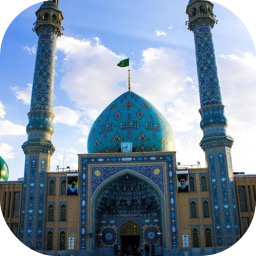

The Guardianship
The Imamate in the Quranic Perspective: The Meanings of the Concept and the Necessity of Infallible Authority
The Quran presents the imamate as a living, infallible authority of guidance that preserves the meaning of revelation from the relativity of human understanding and applies it justly after the passing of the Prophet, binding people to the divine intent.
Introduction: Quranic Epistemology and the Crisis of Human Understanding
In the Islamic vision, the Quranic text represents the final, absolute divine constitution, which came to bring humanity out of epistemic bewilderment and to put an end to the relativity of human rulings and opinions. Yet one of the greatest dilemmas that human thought faces when dealing with any written text is “the dilemma of understanding and application”; for the text, the moment it descends into the world of matter, becomes subject to the divergence of readings and interpretations.
Hence the Shia theological and philosophical school sets out to root the office of the divinely appointed leadershipdivinely appointed leadership — pronounced ‘ih-MAA-mah’ — الإمامة The Arabic term is Imama. It refers to the continuation of prophetic guidance after the Prophet (PBUH): a position appointed by God through which the Imam (AS) guides humanity, preserves the message, and explains its meaning. In Shia theology, this leadership is established by divine designation rather than community election, and the Imam is protected from error and misguidance. not as an intellectual luxury or a secondary political post, but as an epistemological and existential necessity for completing the divine purpose of guidance, relying in that upon the depth of the Quranic indications and the rational entailments.
1. The Quranic Rooting of the Office of the Imamate: Responding to the Problem of the Word and the Attribute
Some researchers may raise an apparent problem to the effect: “There is no explicit verse in the Quran that says, in so many words: follow such-and-such Imam by his literal designation.” The epistemic response to this problem is dismantled through the very methodology of the the Quranthe Quran — pronounced ‘al-Qur'an’ — القرآن Pronounced: al-Qur'an. The Quran is the central scripture of Islam. Muslims believe it is the revealed word of God, sent to Prophet Muhammad (PBUH), and preserved as the primary source for Islamic belief, worship, law, ethics, and spiritual guidance. in establishing the great concepts; for the noble Quran often relies on defining the attributes, qualifications, and functions of the divine office rather than a rigid verbal naming, because the attribute endures and is consistent, whereas the mere word may be subject to interpretive disputes.
The noble Quran spoke of the office of the imamate and the attributes that require following the guides after the Messenger (PBUHPBUH — pronounced ‘sal-lal-LAAH-u alayhi wa aalih’ — صلى الله عليه وآله Peace and blessings be upon him and his family. This expression is used after mentioning Prophet Muhammad (PBUH) as an act of reverence and obedience to the Quranic command to send blessings upon him.) through firm verses that establish this integrative line.
1. The Nature of Divine Appointment and the Condition of Infallibility: The Verse of Trial
God, glorified and exalted, says in His firm Book:
“And when his Lord tried Abraham with certain words and he fulfilled them, He said: I will make you a leader (imam) for the people. He said: And of my progeny? He said: My covenant does not reach the wrongdoers.” (Al-Baqara: 124)
From the theological standpoint: the verse establishes the rule that the imamate is a station not attained by consultation or human election, but is exclusively an issuance of the divine will: “I will make you.” The verse also lays down an absolute condition in the Imam, which is his transcendence above any pattern of injustice: “My covenant does not reach the wrongdoers.” Whoever wronged himself by committing a sin, disobedience, or polytheism at any moment of his life exits rationally from the circle of entitlement, and this is the explicit verbal and attributive proof of the obligation of infallibility and divine protection from errorinfallibility and divine protection from error — pronounced ‘IS-mah’ — العصمة The Arabic term is Isma. In Shia theology, it means God's protection from sin, deliberate error, forgetfulness that would damage religious guidance, and misguidance. For prophets and Imams, it safeguards the reliability of revelation and guidance..
From the philosophical and hierarchical standpoint: the verse reveals that God’s prophet Abraham (AS) attained the station of the imamate at the end of his life, after he had been a prophet, a messenger, and a friend (khalil), and after his success in arduous existential tests. This proves that the imamate is an existential rank distinct from prophethood and messengership; it is an inner and outer leadership rank that requires a spiritual perfection encompassing the governance of human souls and bringing them to their perfective ends.
2. The Standard of Absolute Obedience and the Correlation with the Message: The Verse of Those in Authority
In the context of defining who must be followed, the Truth, glorified is He, says:
“O you who have believed, obey Allah and obey the Messenger and those in authority among you.” (Al-Nisa: 59)
The obligation of obedience here came joining the obedience of the Messenger (PBUHPBUH — pronounced ‘sal-lal-LAAH-u alayhi wa aalih’ — صلى الله عليه وآله Peace and blessings be upon him and his family. This expression is used after mentioning Prophet Muhammad (PBUH) as an act of reverence and obedience to the Quranic command to send blessings upon him.) and those in authority in a single matter in which the imperative verb was repeated: “and obey the Messenger and those in authority.” Rationally, the absolutely Wise does not command obedience to a person in a decisive, absolute manner parallel to obedience to the Messenger unless that person is infallible from error and slip; otherwise it would entail the command of disobedience upon the ruler’s error, which is impossible. So the Quran here defined the attribute of “those in authority” by complete infallibility and the obligation of absolute following, which corresponds to the attributes of the Imams (AS).
3. The Verse of the Truthful and the Command of Absolute Companionship
God, exalted is He, says:
“O you who have believed, be mindful of Allah and be with the truthful.” (Al-Tawba: 119)
The theological inference: the Quran directs an address to the believers in every age and land regarding the obligation of accompanying “the truthful” and being with them absolutely, without restriction by any condition. And since the command is divine and absolute, it is rationally impossible for these truthful ones to be among those for whom lying, error, or deviation is possible; otherwise God would have commanded being with error, which is inherently ugly and impossible for the Wise. So the verse affirms the attribute of “absolute truthfulness” — that is, infallibility — in a group around which the nation must gather, and they are the Imams (AS).
4. The Verse of Continuous Guidance and the Persistence of the Proof
God, glorified is He, says:
“You are only a warner, and for every people there is a guide.” (Al-Ra’d: 7)
The philosophical and theological dimension: the verse distinguished between two stations — the station of the “warner,” represented by the person of the noble Messenger (PBUHPBUH — pronounced ‘sal-lal-LAAH-u alayhi wa aalih’ — صلى الله عليه وآله Peace and blessings be upon him and his family. This expression is used after mentioning Prophet Muhammad (PBUH) as an act of reverence and obedience to the Quranic command to send blessings upon him.), which is the station of founding and legislation, and the station of the “guide,” who undertakes the guidance of every people and generation after the absence of the warner. The rational indication here is clear in the extension of the line of guidance: “and for every people there is a guide.” The earth is not, philosophically, devoid of a guide who protects people from bewilderment and connects the world of matter to the world of the unseen, and this is the very office of the continuous imamate.
5. The Verse of Guardianship and the Restriction of the Highest Authority
God, exalted is He, says:
“Your guardian is only Allah, His Messenger, and those who believe — those who establish prayer and give charity while bowing.” (Al-Ma’ida: 55)
The theological inference: the restricting particle “only” (innama) confines the absolute, governing guardianship of the nation to three connected parties: Allah, His Messenger (PBUHPBUH — pronounced ‘sal-lal-LAAH-u alayhi wa aalih’ — صلى الله عليه وآله Peace and blessings be upon him and his family. This expression is used after mentioning Prophet Muhammad (PBUH) as an act of reverence and obedience to the Quranic command to send blessings upon him.), and those who believe among whom the giving of charity occurred in the state of bowing — an attribute historically and theologically established in the occasions of revelation for the Commander of the Faithful Ali ibn Abi Talib (23 BH–40 AH / 599–661 CE) (ASAS — pronounced ‘alayhi as-salaam’ — عليه السلام AS stands for “peace be upon him / her / them.” It is the English abbreviation of the Arabic expression “alayhi / alayha / alayhim as-salam.” This expression is used after mentioning prophets (AS), the Imams (AS), Lady Fatima (AS), Sayyida Zaynab (AS), Lady Khadijah (AS), and Ahl al-Bayt (AS) as a sign of respect.), which makes obedience to him and following him an essential extension of the guardianship of God and His Messenger.
2. The Hermeneutical Impasse and the Necessity of the Infallible Interpreter
Upon moving from the stage of the text to the stage of understanding, we face the great hermeneutical dilemma.
Hermeneutics, in brief, is the science of interpretation and the philosophy of understanding texts, which investigates how the cultural, environmental, and psychological backgrounds of the interpreter affect his way of deriving meaning.
According to this concept, the non-infallible human interpreter does not read the text in a stripped-down manner; rather he enters it laden with a subjective “historical horizon” formed from his environment, his school of thought, his political circumstances, and his personal experiences. This inevitable projection of the interpreter onto the text necessarily produces an immense multiplicity and a sharp conflict in interpretations, which casts the human readings into the relativity of knowledge.
Here the problem of the non-religious or the one impugning the authority of the Quran comes to the fore, as he adduces the abundance of these interpretations and their contradiction to say:
“This text has turned from a source of guidance and of bringing people out of epistemic bewilderment into a source of fragmentation, multiplicity of opinions, and contradiction, which makes it a mere reflection of relative human interpretations.”
The Philosophical Solution: The Imam as the Speaking Quran
The Shia school does not stand against the movement of thought and rational inquiry, but it affirms that there is no independent reasoning and no interpretation by mere opinion in the face of the infallible understanding. To exit the vortex of relativity and epistemic bewilderment, divine wisdom requires the existence of an infallible interpreter, free of desires and historical biases, who possesses the real understanding entirely corresponding to the divine intent of the verses.
The noble the Quranthe Quran — pronounced ‘al-Qur'an’ — القرآن Pronounced: al-Qur'an. The Quran is the central scripture of Islam. Muslims believe it is the revealed word of God, sent to Prophet Muhammad (PBUH), and preserved as the primary source for Islamic belief, worship, law, ethics, and spiritual guidance. is a silent text between the two covers, bearing many faces, and the infallible Imam is the “infallible translator” and the speaking Quran who lifts the disagreement and safeguards the text from misattribution, distortion, and ignorant interpretation.
3. The Roles of the Imam and His Function in Preserving the Religion and Applying the Sharia
The roles of the Imam after the passing of the noble Messenger (PBUHPBUH — pronounced ‘sal-lal-LAAH-u alayhi wa aalih’ — صلى الله عليه وآله Peace and blessings be upon him and his family. This expression is used after mentioning Prophet Muhammad (PBUH) as an act of reverence and obedience to the Quranic command to send blessings upon him.) are defined in two main spaces, with a decisive emphasis on the distinction between the stations of prophethood and the imamate.
1. Preserving the Religion and Expounding It: Without Founding Legislation
It must be clarified here, to prevent any confusion: God’s prophet Abraham (AS) and the noble Messenger Muhammad (PBUHPBUH — pronounced ‘sal-lal-LAAH-u alayhi wa aalih’ — صلى الله عليه وآله Peace and blessings be upon him and his family. This expression is used after mentioning Prophet Muhammad (PBUH) as an act of reverence and obedience to the Quranic command to send blessings upon him.) combined the stations of prophethood, messengership, and the imamate together. As for the Imams of the Household (AS), they are Imams and are neither prophets nor messengers. With the death of the final Messenger (PBUHPBUH — pronounced ‘sal-lal-LAAH-u alayhi wa aalih’ — صلى الله عليه وآله Peace and blessings be upon him and his family. This expression is used after mentioning Prophet Muhammad (PBUH) as an act of reverence and obedience to the Quranic command to send blessings upon him.), the legislative revelation was cut off and the time of founding universal rulings and new legislations ended entirely.
The role of the Imam is not to originate a new religion, but to preserve the final revealed Islamic law and pathrevealed Islamic law and path — pronounced ‘sha-REE-ah’ — الشريعة The Arabic term is Sharia. It is Islam's revealed path of worship, law, ethics, and practical guidance. It is not limited to criminal law; it includes prayer, family life, social justice, business ethics, purification, and how a person lives before God. from distortion and to expound its obscurities. The Prophet (PBUHPBUH — pronounced ‘sal-lal-LAAH-u alayhi wa aalih’ — صلى الله عليه وآله Peace and blessings be upon him and his family. This expression is used after mentioning Prophet Muhammad (PBUH) as an act of reverence and obedience to the Quranic command to send blessings upon him.) founded the edifice and expounded it, and the Imams (AS) are the infallible guards appointed to maintain this edifice and to guard its epistemic boundaries from the changing currents and desires across the ages.
2. The Just Application of the Sharia and the Management of Society
The second role is leadership and the actual application of the divine rulings in the reality of social and political life. The Sharia sets down the frameworks and broad lines, and applying it to the letter without injustice or bias requires a leader who possesses perfection in justice and knowledge. The Imam is the central axis around which the nation gathers so that its spiritual and material course may be united, thereby realizing the highest purpose of the sending of the messengers and the building of virtuous societies.
4. Rejecting “Horizontal Parity” in Islamic Thought
The grievous epistemic and historical error into which contemporary readings have fallen is placing the views and readings of the Imams of the Household (AS) horizontally — that is, alongside — the other human views and interpretations, and portraying the matter as though there were multiple schools: the four Sunni schools, and alongside them the Shia Ja’fari school.
From the perspective of the philosophy of the imamate and the Quranic rooting, the word of the Household (AS) is not a human sectarian reasoning that admits error and correctness in the face of another sectarian reasoning; rather it is the infallible, pure extension of the Sunnah of the Prophet (PBUHPBUH — pronounced ‘sal-lal-LAAH-u alayhi wa aalih’ — صلى الله عليه وآله Peace and blessings be upon him and his family. This expression is used after mentioning Prophet Muhammad (PBUH) as an act of reverence and obedience to the Quranic command to send blessings upon him.). They represent the fixed normative origin and the safeguarded source against which the rest of the readings and reasonings are measured to know the extent of their correspondence with the revelation — and they are not a sectarian pillar equivalent to readings governed by particular environmental and historical circumstances.
Conclusion
Reason and theological philosophy, when they contemplate the verses of the Wise Book, conclude that the office of the divinely appointed leadershipdivinely appointed leadership — pronounced ‘ih-MAA-mah’ — الإمامة The Arabic term is Imama. It refers to the continuation of prophetic guidance after the Prophet (PBUH): a position appointed by God through which the Imam (AS) guides humanity, preserves the message, and explains its meaning. In Shia theology, this leadership is established by divine designation rather than community election, and the Imam is protected from error and misguidance. is a necessity required by the divine grace in its wisdom. For the Book intended to be an eternal guidance and constitution for humanity necessarily requires, by philosophical necessity, a living infallible proof who interprets it by its reality and applies it by its justice, to be the axis of the millstone and the fixed standard that prevents the nation from dividing and falling into the snare of the fragmentation of opinions and the relativity of human understanding.
The Book intended to be an eternal guidance and constitution for humanity necessarily requires, by philosophical necessity, a living infallible proof who interprets it by its reality and applies it by its justice.