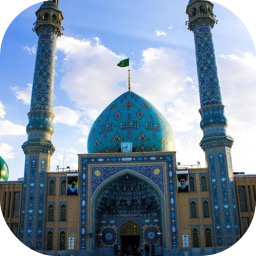

The Guardianship
The Imamate as the Successorship of the Message: The Extension of Tawhid and the Rational Necessity of Infallibility and Divine Support
The imamate is not a human political office to be elected; it is a doctrinal extension of divine oneness and prophethood, in which reason requires divine appointment, absolute infallibility, and divinely-granted knowledge to safeguard the message after the Prophet.
Introduction: The Imamate as an Existential Necessity, Not a Political Office
When the question of succession or imamate is raised after the departure of the greatest Messenger (PBUHPBUH — pronounced ‘sal-lal-LAAH-u alayhi wa aalih’ — صلى الله عليه وآله Peace and blessings be upon him and his family. This expression is used after mentioning Prophet Muhammad (PBUH) as an act of reverence and obedience to the Quranic command to send blessings upon him.), traditional political thought tends to reduce the matter to its administrative and worldly dimension, describing it as a mere managerial and executive office whose affair reverts to human choice and the process of the ballot box or ordinary consultation. Yet the deep and methodical reading of the reality of religion, the structure of the human being, and the purposiveness of creation reveals the collapse of this reduction and establishes that the imamate is, of necessity, a divine office, and an existential node completing the project of the message.
The imamate, in its reality, is not a human social contract; it is a doctrinal and essential extension of the foundation of divine oneness and divine justice. In this article, we will dismantle the rational and philosophical proofs that establish the inevitability of the divine appointment of the Imam, the necessity of his absolute infallibility, and his support by divinely-granted and unseen knowledge — arriving at a clarification of how true divine onenessdivine oneness — pronounced ‘tau-HEED’ — التوحيد The Arabic term is Tawhid. It means the oneness of God: faith in His absolute wisdom, justice, and transcendence above every partner, limit, error, or purposeless act. negates futility and entails the imamate as an inevitable branch of the message.
1. The Doctrinal Sequence of the Ranks of Guidance (Oneness, Prophethood, Imamate)
To understand the origin of the imamate, we must set out from the fundamental root of all the Sharia, which is divine oneness.
The Chain of Guidance:
True Divine Oneness
↲ Prophethood and Messengership (a branch of it)
↲ The Infallible Imamate (a branch of it)
1. True Divine Oneness and Transcending Allah Above Futility
divine onenessdivine oneness — pronounced ‘tau-HEED’ — التوحيد The Arabic term is Tawhid. It means the oneness of God: faith in His absolute wisdom, justice, and transcendence above every partner, limit, error, or purposeless act. in Islam is not a mere mental affirmation of the Creator’s might and His numerical oneness; it is a faith in His absolute wisdom and His justice. True divine oneness is transcending Allah, glorified and exalted, above futility and error. It is neither reasonable nor logical for a wise, all-aware Lord to create this complex universe, and to create the human being with his unique composition, then to leave him neglected without a purpose, or to leave him butting heads in the darknesses of ignorance and caprice without a clear authority to lead him toward the perfection ordained for him.
2. Prophethood Is a Branch of Divine Oneness
Since Allah is transcendent above futility, and since the purpose of creation is guidance and attaining knowledge of Him, blessed and exalted, it was of the Creator’s wisdom to send the prophets and messengers. Prophethood, then, is a tangible embodiment of the rule of divine grace and His care for humanity. Prophethood is a direct branch of divine oneness; because negating prophethood is a negation of divine wisdom, an affirmation of futility in creation, and a suspension of the purpose of guidance.
3. The Imamate Is a Branch of Prophethood and an Extension of It
If prophethood was cut off, as regards the reception of legislative revelation, with the death of the seal of the Messengers (PBUHPBUH — pronounced ‘sal-lal-LAAH-u alayhi wa aalih’ — صلى الله عليه وآله Peace and blessings be upon him and his family. This expression is used after mentioning Prophet Muhammad (PBUH) as an act of reverence and obedience to the Quranic command to send blessings upon him.), the other functions of prophethood were not cut off and will not be cut off so long as there are humans on the earth. These functions consist of: preserving the religion from distortion, expounding the summaries of the Sharia, leading the nation toward its spiritual and material perfection, and realizing justice on the earth.
Based on this correlation, the imamate is an inevitable branch of prophethood; the prophet lays the foundational cornerstone of the Sharia, and the Imam undertakes to safeguard, apply, and preserve it across the generations. And true divine oneness, in its philosophical depth, is not completed unless we transcend Allah above futility and believe in the imamate; because to say that Allah sent a prophet for a few years and then, after his death, left the religion and the nation to the winds of caprice and contradictory human reasonings is the very futility that contradicts the perfection of divine oneness.
2. The Demonstrations of the Need for Divine Appointment and the Refutation of the Option of Human Election
An objector may present a differing view to the effect:
“We are content with a learned, pious person, possessing political acumen, whom the people choose and elect to lead the nation and implement the rulings.”
This proposition, despite its apparent attractiveness, collides with a set of rational and scientific paradoxes that refute it:
1. The Paradox of “the Ignorant Choosing the Specialist”
From the purely rational standpoint, in order to choose the best in some field, you must have complete acquaintance with the limits and secrets of that field.
- The example of the physician: If we wish to choose “the most knowledgeable and most understanding” among physicians to treat an intractable disease, we cannot resort to a ballot box in which the general public, ignorant of medicine, participate. To choose the most knowledgeable physician, you must be versed in the sciences of medicine, and in the credentials and specialties of the physicians precisely, so as to say that this one is better than that.
- The gravity of the office of the caliphate: The office of the succession of the Prophet and the governance of the spirit, religion, and society is harder, more complex, and more perilous than any other worldly specialty. So how is it logically reasonable to leave to the general public — with their varying levels of awareness and knowledge, subject to influences and propaganda — the task of electing and appointing the one who represents the extension of the divine message? This is a clear rational collapse; for the ignorant does not possess the tools to evaluate the most knowledgeable in the affairs of the dominion (malakut) and the Sharia.
A caution and an essential distinction: We here are not against the democratic electoral process in purely worldly matters and arrangements (such as the running of municipalities, civil organization, and changing human interests). Rather our discussion bears exclusively on the office of the one who will succeed the Prophet after his death — that is, the one who will bear the burden of the guardianship of the message. And since the message is, in its origin, a divinely-appointed station, the successor bearing the same tasks must be an office appointed by a subsequent divine decision, not by a human democratic choice.
2. The Incapacity of Humans to Evaluate the Inner Ranks of Faith
Even if we suppose that the people are indeed searching for the righteous, pious man, we fall into a great epistemic problem: righteousness, faith, and piety are not static attributes; they are ranks and gradations that differ from one person to another.
- There is no human who possesses the ability to look upon the secrets of hearts and the depth of consciences so as to classify who has traversed all the ranks of faith and reached its latent summit.
- The only One acquainted with the reality of righteousness in the inner being of the human is Allah, glorified and exalted. Accordingly, the only party qualified to name and appoint this “most righteous” is the divine will, and reliance on human choice here is mere guessing at the unseen and conjecture.
3. The Inevitability of Divinely-Granted and Unseen Knowledge and the Duality of “Matter and Spirit”
The humanly-appointed ruler, however great his genius, still has acquired human epistemic tools (resting on study, experience, and trial and error). This epistemic incapacity renders purely human leadership incapable of realizing the intent of Allah on three counts:
1. The Duality of the Outer and Inner of the Text
Religion and Islamic legislation bear two dimensions: an outer and an inner.
- The jurists (mujtahids) and scholars may be equal in the knowledge of “the outer of the text” (the formal and linguistic jurisprudential rules).
- As for “the inner of the text,” it is an unseen, dominion-related affair that includes the true purposes and the actual causes of the legislation. The only path to knowing the inner of the text is divine effusion and the Lord’s support. The human ruler who leads the nation by the outer of the texts alone will inevitably be incapable of understanding the essence of religion at the great calamities.
2. The Duality of Matter and Spirit and Avoiding “Hidden Materialism”
The human being is not a mere material biological creature that consumes and produces; his greatest reality and his original essence is the spirit.
- The spirit is an unseen affair reserved to the knowledge of the Maker, mighty and majestic. The ordinary righteous ruler may understand the material and social nature of the human, but he is entirely incapable of understanding the spiritual nature, its nourishment, and its points of weakness.
- The gravity of neutralizing the spiritual side: If we neutralize the unseen spiritual side in issuing the legal rulings and in managing the nation, and content ourselves with the worldly material appearances for conducting the affairs of religion, we will have fallen into “materialism” without realizing it. And then the critique of the materialist philosophers with a million theoretical and critical proofs will not avail us, because in the reality of practice and legislation we will have codified religion and turned it into a purely material affair and suspended its spiritual essence.
- Therefore, the true leader must combine knowledge of the biological nature and the unseen spiritual nature of the human, which requires a divinely-granted knowledge supported by Allah, or a knowledge inherited in full, unseen and directly, from the Messenger (PBUHPBUH — pronounced ‘sal-lal-LAAH-u alayhi wa aalih’ — صلى الله عليه وآله Peace and blessings be upon him and his family. This expression is used after mentioning Prophet Muhammad (PBUH) as an act of reverence and obedience to the Quranic command to send blessings upon him.).
3. The Dilemma of Judging by Actual Justice
In human judiciary, positive laws — and even jurisprudence resting on the outer — rule by what is “on the table” of material evidence (witnesses, papers, apparent indications).
- If ten professional persons commit perjury and conspire against an innocent person, then the human judge who is not supported by the unseen will content himself with the outer and will inevitably rule against this innocent one.
- In such a case, actual justice is absent, and the divine wisdom of creation is struck at its heart, because the injustice has been legitimized under a legal cover.
- Accordingly, reason requires the existence of a leader for the nation who is acquainted with the realities of matters “as they are in reality and in themselves,” not as people portray and falsify them; and this acquaintance is only by support and direct unseen knowledge from Allah.
4. The Demonstration of “Empirical Impossibility in Human Societies”
Among the greatest errors into which human political theories fall is treating human society as a field of experiments. Here an essential difference emerges:
- The society of laboratory flies: In scientific and biological laboratories, scientists can study organisms such as “fruit flies,” where many generations are born and die within a few days. This allows the scientist to observe the effect of a particular factor or mutation on several successive generations rapidly and reliably before arriving at a conclusion and generalizing it.
- The complex human society: Human society is far more perilous; for the leader who lays down the social theory, the economic school, or the personal religious interpretation is himself a human governed by a limited lifespan and will die quickly. This leader cannot remain alive for extended centuries to see whether his interpretation and theory will produce welfare for the coming generations or ruin and deviation.
The outcomes of unsupported human reasoning:
- The delusion of the contemporary generation: the generation that lived alongside the leader may drum up support for his theory or reasoning, supposing him to be the unique one of his age, based on a temporary revival or a narrow immediate interest.
- The curse of the later generations: after centuries, and with the development of humanity and the discovery of new facts, the later generations may discover that those personal theories and decisions wrecked the human being and rooted injustice, corruption, and distortion; so the later generations curse that leader.
- Entanglement in blood and misguidance: the human leader dies and passes away, but he leaves behind him a nation entangled — either in blood spilled on the basis of his erroneous political or jurisprudential decisions, or in a doctrinal and spiritual deviation that destroyed generation after generation.
To avoid the historical catastrophe resulting from experimenting with laws and individual opinions on the destinies of humans, this leader must, rationally, be supported and confirmed by Allah, who knows the unseen and knows absolutely what benefits people and what harms them across the centuries and the future.
5. The Demonstration of the Clearing of Liability and the Inevitability of Absolute Infallibility
The necessity of the imamate is linked to the question of divine justice in the reckoning and recompense on the Day of Resurrection, and from this link two decisive demonstrations spring:
1. The Demonstration of “the Clearing of Liability” Before Allah
Allah, glorified and exalted, is just and does not wrong even the weight of a mote. So if Allah commanded the nation, in an absolute command, to obey and follow a leader after the Prophet, then it is rationally impossible for this leader to issue an erroneous decision or a deviant ruling (whether in acts of worship that become void, or in political and fateful decisions that lead to death and false wars), and then for Allah to punish the people and hold them to account on the Day of Resurrection for having followed that leader!
For the servant to be entirely cleared of liability before Allah on the Day of Reckoning when following the leader, this leader must be infallible and supported, neither erring nor slipping; otherwise, were error possible for him, obligating people to follow him would become obligating them to falsehood, which is impossible for Allah.
2. The Hidden Ranks of the Caprice of the Self
An objector may say:
“We choose a very righteous and pious man, so he does not commit injustice.”
The response to that is that “the caprice of the self” has very hidden and complex ranks. The righteous person may transcend the apparent material desires (such as money and women), but he may fall into hidden ranks of caprice, such as: the love of leadership, the lust to impose one’s opinion, or his admiration for his own particular method of reform and his supposition that it is the absolute truth.
These subtle psychological slippery slopes cannot be settled by acquired, apparent piety; rather they require, rationally, that this person be infallible with an absolute infallibility by the testimony and appointment of Allah (who knows the treachery of the eyes and what the breasts conceal), and not by our claim or by our deficient conjecture and endorsement.
Conclusion: The Imamate Completes Divine Oneness and Transcends Creation Above Futility
Tracing this methodical chain of rational and philosophical proofs leads us to a single, inevitable, inescapable conclusion: the caliphate or imamate that expresses the extension of the message must be a divine office by appointment and text, and its holder must be infallible and supported by unseen or divinely-granted knowledge.
Divine oneness negates futility ↲ entails prophethood for guidance ↲ entails the imamate for the preservation of the Sharia
The conditions of the imamate, rationally:
- Divine appointment (not election).
- Absolute infallibility (for the clearing of liability).
- Divinely-granted knowledge (to lead the spirit and the inner).
To accept the theory of “human appointment” and non-infallible leadership is to accept — without its proponent realizing it — the transformation of religion into a material system with a formal outer appearance, and the thrusting of society into a tragic field of experiments and a gamble with the lives and religion of the nation on the basis of personal opinions that die with the death of their holders.
As for true divine oneness, resting on the absolute wisdom of Allah and His transcendence above futility and error, it is what binds the earth to heaven in a continuous, unbroken bond; it believes that the Allah who began guidance with prophethood and messengership completed and safeguarded it with the supported imamate, so that religion may remain fresh and tender, and so that the purpose of the creation of humans may be realized in drawing near to Allah with a pure spirit, an enlightened intellect, and a complete clearing of liability on the Day of the Greatest Presentation.
True divine oneness, resting on the absolute wisdom of Allah and His transcendence above futility, is what binds the earth to heaven in a continuous, unbroken bond; for the Allah who began guidance with prophethood completed and safeguarded it with the supported imamate.